

Answer engine optimization, or AEO, is the practice of making your expertise easy for AI answer engines to find, understand, verify, extract, cite, and recommend.
Good AEO combines the boring parts of SEO that still work with the parts machines cannot easily manufacture: first-hand experience, original research, useful frameworks, clear opinions, credible evidence, and a consistent reputation across the web.
The goal is not to trick ChatGPT into saying your name. The goal is to become the source it would look foolish to ignore.
| The short version: Be crawlable. Answer a real buyer question. Make the answer clear. Prove it. Earn corroboration elsewhere. Measure whether visibility turns into qualified conversations. |
The seven things to remember
- AEO adds a new visibility layer to SEO. It does not replace SEO.
- AI engines often break one question into several related searches before answering it.
- A page must be discoverable before its clever formatting matters.
- Direct answers, definitions, comparisons, steps, evidence, and original examples are easy to reuse accurately.
- Structured data can clarify meaning, but there is no magic AEO schema.
- One answer from one chatbot is not a measurement system.
- Citations are useful. Leads and revenue still pay for lunch.
A short note from someone who has watched search grow up
I have worked in SEO since 2006. Back then, the job was easier to explain. Find what people typed into Google, create the best page for it, earn links, and climb the blue ladder.
Now a prospect can ask an AI assistant to compare three coaches, explain their methods, estimate the investment, summarize the risks, and suggest who fits their situation. They can build a shortlist without visiting a single homepage.
The search results page did not disappear but now it’s becoming a conversation people are having with their favourite AI chatbots.
For creators, coaches, and consultants, that changes the job. We are no longer trying only to rank a page. We are trying to become the definition, example, source, or recommendation that survives inside the answer.
That sounds futuristic. The practical work is surprisingly earthy. Publish something worth repeating. Make your expertise legible. Leave enough proof that a skeptical machine and an even more skeptical human can verify it.
What is answer engine optimization?
Answer engine optimization is the process of improving how often, how accurately, and how persuasively a brand or source appears in AI-generated answers.
Those answers may appear in ChatGPT search, Google AI Overviews, Google AI Mode, Perplexity, Microsoft Copilot, Gemini, Claude, or another system that retrieves web sources before producing a response.
AEO usually aims to improve five outcomes:
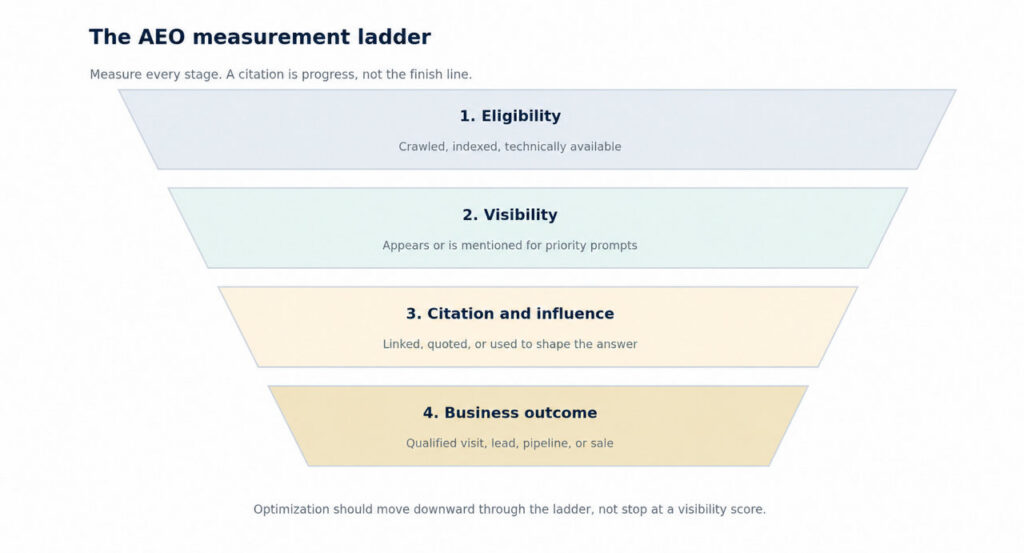
- Discovery: Can the engine find and access your page?
- Retrieval: Does your page match the question and its related subtopics?
- Selection: Is your information strong enough to be chosen as evidence?
- Citation: Is your page named or linked in the answer?
- Influence: Does your evidence shape the recommendation, click, lead, or sale?
The last point matters. A page can be cited in a footnote nobody notices. Another page can supply the central idea that changes the buyer’s decision. Citation count alone cannot tell you which one happened.
AEO, GEO, LLMO, and AI SEO
The names are multiplying faster than mushrooms after rain.
In practice, AEO, GEO, LLMO, and AI SEO describe overlapping work. Google treats optimization for its generative search features as part of SEO. The academic literature often uses generative engine optimization, or GEO. Marketers use AEO because it describes the outcome clearly: becoming part of the answer.
| Term | Main emphasis | Useful way to think about it |
| SEO | Ranking and earning clicks in search results | Get found |
| AEO | Appearing in direct answers and recommendations | Become the answer |
| GEO | Gaining visibility in generative search responses | Influence the generated response |
| LLMO | Making information understandable and retrievable by language models | Make your expertise machine-legible |
Do not waste a quarter debating the acronym. Your customer certainly is not.
AEO versus SEO
SEO still matters because many answer engines use search indexes, crawlers, and ranking systems to retrieve current information. Google’s official guidance is especially blunt: the foundation for AI Overviews and AI Mode is still strong SEO and helpful content.
The difference is what happens after retrieval.
| SEO question | AEO question |
| Can this page rank for a query? | Can this source support an answer? |
| Does the title earn a click? | Can the content be quoted or summarized accurately? |
| How much organic traffic did we earn? | How often were we mentioned, cited, and recommended? |
| Which keywords drive sessions? | Which buyer prompts and subquestions trigger us? |
| How many links point to the page? | Who independently confirms the claim or entity? |
| Did the visitor convert? | Did AI visibility influence a qualified visit, lead, or sale? |
SEO helps you enter the candidate pool. AEO helps your information survive the selection and synthesis process.
Treat them as one system. Separating them into rival camps is mostly a good way to sell two retainers.
How answer engines assemble an answer
Every platform works differently, and the details change. Still, most retrieval-based answer experiences follow a recognizable path.
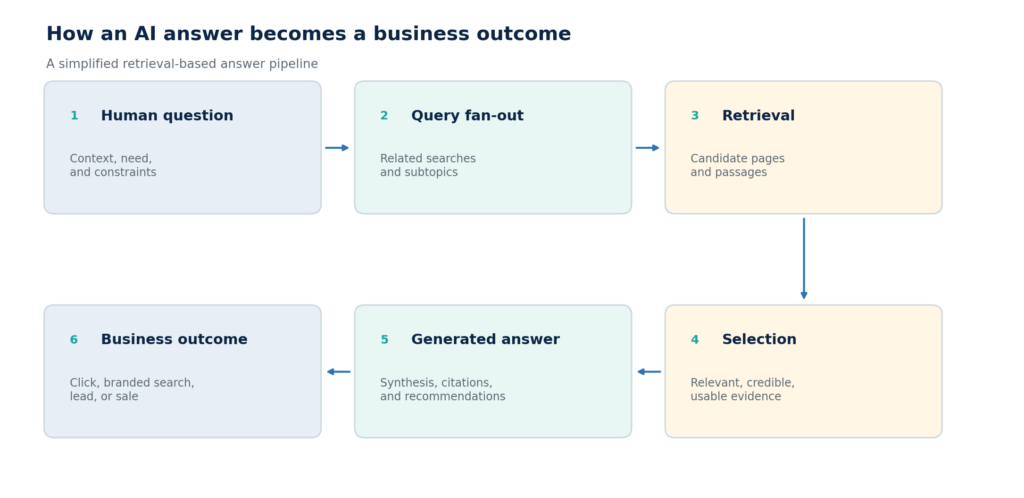
1. The user asks a messy human question
People do not speak in tidy keywords. They give context, preferences, fears, budgets, and follow-up questions.
Someone may ask, “What is the best group coaching model for an ADHD business owner who hates weekly calls?” That is several problems wearing one trench coat.
2. The engine expands the question
Google calls this query fan-out. ChatGPT search also says it may rewrite a prompt into one or more targeted searches.
One user question can trigger searches about group coaching formats, ADHD-friendly delivery, asynchronous support, pricing, retention, and alternatives. This means one giant keyword is less useful than a well-covered topic with clear internal connections.
3. The system retrieves candidate sources
It may use its own index, search partners, live web retrieval, licensed data, or a mix. If your page is blocked, buried, stale, or rendered in a way the crawler cannot understand, it may never enter the room.
4. The system selects useful passages
Relevance is not enough. The engine needs text that can support a claim. Definitions, numbers, comparisons, procedures, examples, and sourced statements are easier to use than warm fog.
5. The model writes the answer
The model combines retrieved material with its reasoning and language generation. It may cite several sources, one source, or none. It may also misunderstand a source, which is why clarity and monitoring matter.
6. The user decides what to do next
They may click. They may search your brand later. They may ask a follow-up. They may copy your framework into a buying conversation without ever appearing in your analytics.
That is why AEO measurement needs more than referral traffic.
The Social Creators CITED framework
If you remember one framework from this guide, use CITED.
CITED stands for Crawlable, Intent-matched, Trustworthy, Extractable, and Distributed. Each layer solves a different failure point.
C: Crawlable
Your best idea is useless to an answer engine if it cannot access the page.
Make sure important pages:
- Return a normal 200 status code.
- Are not blocked by robots.txt, a firewall, a login, or a noindex tag.
- Appear in an XML sitemap.
- Have internal links from relevant pages.
- Use a clear canonical URL.
- Put essential information in readable HTML text.
- Work on mobile and load without a small eternity.
This is the least glamorous part of AEO. It is also the floor holding up everything else.
I: Intent-matched
Do not optimize for a list of isolated keywords. Build around the decisions your buyer is trying to make.
A coach researching masterminds may ask:
- What is a coaching mastermind?
- Is a mastermind different from group coaching?
- How much should a mastermind cost?
- What should be included?
- How many members should it have?
- Why do masterminds fail?
- Should I join one or build one?
These questions form a decision journey. AEO content should cover the journey without producing 47 thin pages that all say roughly the same thing.
The best topic clusters have one strong hub, focused supporting pages, and obvious internal links between them.
T: Trustworthy
Machines need evidence because people do.
Trustworthy content shows:
- Who wrote it and why they know the subject.
- When it was published or meaningfully updated.
- Which claims come from first-hand experience.
- Which claims come from outside research.
- How a number was calculated.
- What the limitations or exceptions are.
- Where a reader can verify the source.
Do not sprinkle citations like parsley. Use them where they make a claim stronger or easier to verify.
First-hand experience is especially valuable for an expert-led business. Share the process, the awkward bit, the failed attempt, and the lesson. Generic summaries are cheap. Earned insight is scarce.
E: Extractable
Extractable does not mean robotic. It means the useful part is easy to locate and hard to misunderstand.
Use:
- A direct answer near the start of the section.
- Descriptive headings written in natural language.
- Short paragraphs with one main idea.
- Definitions that name the subject clearly.
- Tables for real comparisons.
- Numbered steps for a genuine sequence.
- Bullets for options, criteria, or checks.
- Examples that make an abstract idea concrete.
- Source links beside the claims they support.
Google says you do not need to chop every article into tiny AI-sized crumbs. Good. Nobody wants to read a website written like a bag of fortune cookies.
Structure for the reader. Clear structure also makes accurate extraction easier.
D: Distributed
Your website says you are brilliant. Naturally, it has a slight conflict of interest.
Answer engines can compare what you say about yourself with what the rest of the web says. Build legitimate corroboration through:
- Podcast interviews with useful show notes.
- Guest articles on relevant publications.
- Conference and event speaker profiles.
- Association directories and professional profiles.
- Real reviews on credible platforms.
- Partner pages and client case studies.
- Expert quotations in other people’s research.
- Original reports that other writers cite.
The goal is not to manufacture mentions. Google explicitly warns against inauthentic mention campaigns. Earn references by creating ideas, evidence, and tools that are worth referencing.
What the latest research says
The foundational GEO research tested several ways of rewriting source content. In a controlled Perplexity experiment, quotations and statistics improved the study’s visibility measures, while keyword stuffing performed poorly on the position-adjusted measure.
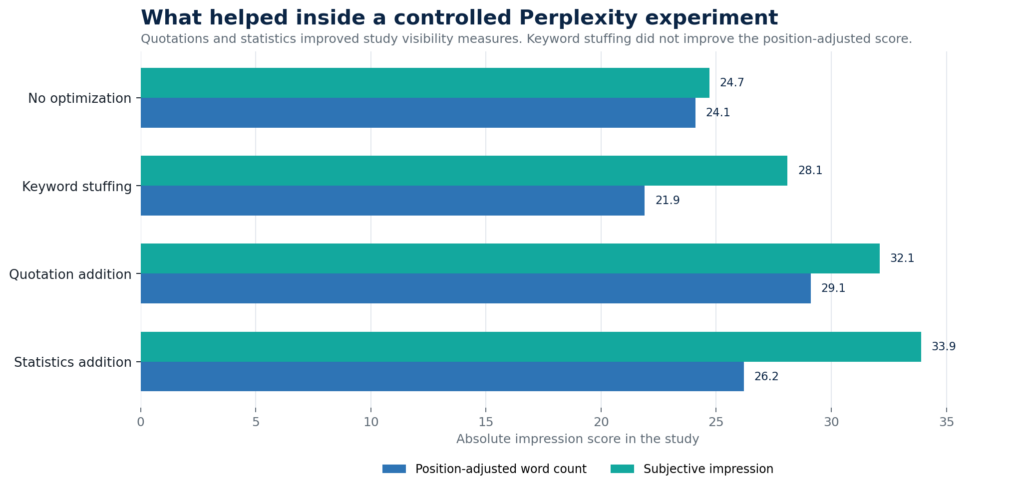
The broader benchmark reported gains of up to 40 percent for some combinations of citations, quotations, statistics, and improved presentation. That finding is useful, but it is often oversold.
The experiment mostly tested how already-retrieved sources were used inside generated answers. It did not prove that adding three statistics to a weak page will create durable rankings, traffic, or sales across every platform.
A 2026 critical review of GEO research makes the distinction clear. Discovery, retrieval, citation, influence, and business outcomes are separate stages. A tactic that helps at one stage may not solve another.
| Use the research as a compass, not a coupon code. Evidence, clear writing, and credible quotations can make a source easier to use. They do not exempt you from relevance, authority, crawlability, or patience. |
The practical lesson
The research supports four habits that were already good publishing:
- Add specific, verifiable evidence.
- Quote credible people when their words add meaning.
- Cite primary sources close to the claim.
- Improve clarity without stuffing keywords or inflating the tone.
Authority is demonstrated. It is not created by typing “as a leading expert” twice.
Find the prompts that can create customers
Traditional keyword tools show typed searches. AEO research also needs conversational prompts, comparisons, follow-ups, and situations.
Start with real language from:
- Sales calls.
- Client onboarding forms.
- Email replies.
- Community questions.
- Search Console queries.
- Site search.
- Reviews of you and your competitors.
- Reddit, forums, and specialist communities.
- Customer support tickets.
Do not begin by asking an AI to invent 500 prompts. Begin with what buyers already ask. Then use AI to expand, group, and stress-test the list.
Build a buyer-question map
| Buyer stage | Prompt pattern | Example for a coach or consultant |
| Problem aware | Why is this happening? | Why do I keep abandoning my content plan? |
| Solution aware | What approaches work? | What is an ADHD-friendly content system? |
| Category aware | What is this type of offer? | What is a productized group coaching program? |
| Comparison | Which option fits me? | Mastermind vs course vs one-to-one coaching |
| Risk | What could go wrong? | Why do coaching communities lose engagement? |
| Price | What should I expect to pay? | How much does a business mastermind cost? |
| Proof | Does this work for someone like me? | Examples of consultants scaling with group delivery |
| Action | How do I start? | How do I validate a mastermind before building it? |
Choose 20 to 50 prompts that represent meaningful buying decisions. Include variations by audience, situation, region, and level of experience.
Then prioritize each prompt using four questions:
- Would the right answer change a buying decision?
- Do we have real expertise or evidence to add?
- Are current answers weak, generic, or outdated?
- Can this topic lead naturally to our offer?
If the answer is no four times, let the keyword wander free.
Create non-commodity content
Google’s 2026 guidance for generative search puts unusual emphasis on non-commodity content. That is welcome news for experts.
A commodity article rearranges familiar advice. A non-commodity article contributes something that came from doing the work.
Commodity content
- Ten productivity tips anybody could write.
- A definition copied from the first three ranking pages.
- A comparison with no tests, prices, use cases, or clear verdict.
- A case study that says a client “got amazing results” but reveals nothing else.
- Fifty city pages with the name of the city swapped out.
Non-commodity content
- A framework developed from repeated client work.
- A benchmark with a transparent method and downloadable data.
- A case study with the starting point, intervention, timeline, result, and limitations.
- A first-hand review that explains who should not buy the product.
- A teardown using real examples and clear evaluation criteria.
- A calculator, checklist, template, or diagnostic based on expertise.
- A contrarian conclusion backed by evidence.
The internet does not need more beige porridge. Publish the part only you could know.
The AEO page blueprint
There is no sacred word count. There is, however, a useful sequence.
1. State the question clearly
Use the language a real buyer would recognize. A vague heading such as “Unlocking New Possibilities” tells a crawler almost as little as it tells a person.
2. Give the direct answer
Answer in one short paragraph before adding nuance.
For example:
| What is a productized 1:many offer? A productized 1:many offer is a repeatable coaching or consulting service delivered to a group through a fixed promise, process, cadence, and price. It creates leverage by replacing custom delivery with a system that can serve several clients at once. |
That paragraph can stand alone. The sections below can explain delivery models, pricing, tradeoffs, and examples.
3. Define the boundaries
Explain what the concept includes, what it excludes, and when it does not apply. Good definitions prevent the model from blending your idea into a neighboring category.
4. Add evidence
Use original data, primary research, client evidence, screenshots, calculations, or transparent examples. Link to the source beside the relevant claim.
5. Show the decision
Comparisons should help a reader choose. Include criteria, tradeoffs, who each option fits, and your verdict.
6. Make the process usable
If the topic involves action, provide ordered steps. A numbered list is not decoration. It is a path.
7. Answer the next questions
Add a focused FAQ based on real follow-ups. Do not bolt 40 synthetic questions onto the bottom because somebody on LinkedIn said AI loves FAQs.
8. Show the author and update history
Use a real byline linked to a useful author page. Add relevant experience, not a life story written by your proud aunt.
Show a meaningful update date. Do not change the date every Tuesday without changing the article.
9. Offer a sensible next step
The call to action should match the question. A reader comparing mastermind models may want a calculator, workshop, or strategy call. They probably do not want a popup screaming “BUY NOW” before they finish the definition.
Content formats answer engines can use well
Some formats naturally contain the evidence and structure an answer needs.
| Format | Why it is useful | What makes it citeable |
| Definition page | Resolves category confusion | Clear boundary, examples, related terms |
| Original study | Adds information unavailable elsewhere | Method, sample, raw data, limitations |
| Case study | Shows an outcome in context | Starting point, actions, numbers, timeline |
| Comparison | Supports a buying decision | Criteria, tradeoffs, prices, verdict |
| How-to guide | Answers an action prompt | Ordered steps, requirements, common errors |
| Benchmark | Gives a reference point | Current data, segments, transparent method |
| Calculator or template | Helps the user do the work | Clear inputs, outputs, instructions |
| Expert interview | Contributes first-hand perspective | Specific quotations, biography, context |
| Glossary or hub | Builds topic relationships | Strong definitions and internal links |
For most coaches and consultants, I would recommend prioritizing these three assets:
- A definitive category guide around the offer you sell.
- A proof asset that shows your method working.
- A decision tool that helps the buyer choose or plan.
One excellent case study can do more for AEO than 20 sleepy blog posts.
Build a clear entity, not a cloud of aliases
An answer engine must understand who you are before it can recommend you consistently.
Use the same core facts across your site and credible profiles:
- Your name and brand name.
- A concise description of what you do.
- The audience you serve.
- Your main offers.
- Your location or service area when relevant.
- Your credentials and first-hand experience.
- Your official website and social profiles.
Create a strong About page and author page. Link articles to the author. Link the author to relevant profiles, interviews, books, talks, and projects.
Avoid changing your positioning every two weeks. Reinvention is healthy. Identity soup is harder to retrieve.
What entity consistency looks like
If Social Creators is described as an AI content agency on one page, an ADHD coaching community on another, and a travel mastermind on a third, the machine has a puzzle.
A clearer statement might be:
| Social Creators helps coaches and consultants turn their expertise into productized group offers, useful content, and AI-supported marketing systems that create clients without constant custom work. |
That sentence can evolve, but the central entity and audience should stay recognizable.
Earn third-party corroboration
Owned content establishes your position. Earned content confirms it.
Useful off-site signals include:
- A client describing your method in their own case study.
- A podcast page that names your expertise and links to your site.
- An event profile with your topic, biography, and talk description.
- A publication quoting your original research.
- A software partner listing your integration or certified expertise.
- Thoughtful reviews that mention the result and context.
The best outreach pitch is not “please mention my brand for AEO.” It is “I have something your audience can use.”
Publish original numbers. Offer a sharp expert quote. Create a visual another writer can embed. Help a journalist verify a claim. Teach on someone else’s stage.
Distribution is not a separate chore after publishing. It is how the evidence enters the wider knowledge ecosystem.
Technical Answer Engine Optimization (AEO) checklist
Technical AEO is mostly good crawling, indexing, accessibility, and structured publishing. Here is the practical checklist.
Crawl and index
- Verify important URLs in Google Search Console and Bing Webmaster Tools.
- Keep XML sitemaps current.
- Fix accidental noindex, canonical, redirect, and status-code problems.
- Check that CDNs and firewalls are not blocking legitimate crawlers.
- Link important pages from relevant navigation and content.
- Use stable URLs.
- Submit meaningful updates through IndexNow where appropriate.
Allow search crawlers intentionally
OpenAI separates its search crawler from its training crawler. That means a publisher can allow inclusion in ChatGPT search while expressing a different preference about model training.
An example policy looks like this:
| User-agent: OAI-SearchBot Allow: / User-agent: GPTBot Disallow: / User-agent: PerplexityBot Allow: / |
This is only an example. Review your legal, privacy, and commercial preferences before changing crawler access. Also check Perplexity’s official crawler documentation and current IP ranges, especially if you use a web application firewall.
Put essential information in accessible text
- Do not hide the core answer inside an image.
- Do not require a click, swipe, or form submission to load the main content.
- Use semantic headings and descriptive links.
- Add useful alt text to meaningful images.
- Label buttons, menus, and forms accessibly.
- Keep mobile and desktop content equivalent.
Accessibility helps humans first. It also gives agents cleaner signals about page structure and interactive elements.
Use structured data accurately
Google’s structured data guidance explains how markup helps search engines understand entities and page types. For an expert-led business, useful types may include:
- Organization
- Person or ProfilePage
- Article or BlogPosting
- Event
- LocalBusiness when you have a real location
- Product when you sell an eligible product
The markup must match visible content. Validate it with Google’s Rich Results Test.
Do not add every schema type you can find. Google says there is no special AEO schema, and structured data is not required for its generative search features.
Do you need an llms.txt file?
Not for Google. Its current guidance says Google Search ignores llms.txt for ranking and generative search inclusion.
Other services may experiment with the format. You can add one if a system you care about documents support and you are willing to maintain it. Just do not confuse an optional file with a strategy.
Keep your facts current
Answer engines often retrieve the web to improve freshness. Make prices, dates, policies, availability, and statistics easy to locate and update.
When you revise a page:
- Change the visible update date only when the revision is meaningful.
- Remove or correct obsolete claims.
- Update source links.
- Submit the revised URL for recrawling where useful.
- Keep a short change note on high-stakes evergreen guides.
Freshness is not repainting the date. It is maintaining the truth.
Measure AEO without fooling yourself
AEO results are noisy. The same prompt can produce different sources across models, locations, accounts, and days.
Build measurement in layers.
Visibility metrics
| Metric | Simple definition | What it tells you |
| Prompt coverage | Prompts where the brand appears divided by prompts tracked | Breadth of visibility |
| Citation rate | Valid answers citing your domain divided by valid answers checked | Source selection |
| Mention rate | Answers naming the brand, linked or not | Brand recall |
| Share of voice | Your mentions divided by all tracked brand mentions | Relative visibility |
| Cited-page breadth | Number of unique URLs cited | Whether visibility depends on one page |
| Accuracy rate | Correct brand claims divided by checked claims | Quality of representation |
| Sentiment | Positive, neutral, or negative framing | How the brand is described |
Traffic and business metrics
- AI referral sessions by source.
- Landing pages receiving AI traffic.
- Conversion rate from AI referrals.
- Assisted conversions.
- Branded search growth.
- Leads selecting “AI assistant” in the how-did-you-hear-about-us field.
- Sales calls where the prospect mentions ChatGPT, Perplexity, Copilot, or an AI summary.
- Revenue and pipeline influenced by those touchpoints.
OpenAI says ChatGPT search referral URLs include utm_source=chatgpt.com, which makes direct referral tracking easier. Bing Webmaster Tools now reports total citations, cited pages, grounding queries, page-level activity, and trends across supported Microsoft AI experiences.
Google Search Console also provides reporting for generative AI performance. Use it alongside the normal Performance report and your analytics.
A simple testing protocol
- Choose 25 high-value buyer prompts.
- Group them by topic and buyer stage.
- Record the current answer, cited domains, your presence, competitors, and factual accuracy.
- Repeat prompts several times or use a tool that samples consistently.
- Track by engine, region, language, and device context when they matter.
- Make one meaningful content or authority change at a time.
- Review trends monthly, not emotional weather reports from Tuesday afternoon.
- Connect changes to traffic, leads, and sales.
Never treat one manual prompt as proof. Answer engines are stochastic. Your screenshot is a story, not a baseline.
AEO tools worth considering in 2026
There is a wide market of AEO platforms and I’ve covered the Best AI Search Visibility Tools And GEO Trackers previously.
Start with the free stack
Most creators do not need an enterprise platform on day one.
Use:
- Google Search Console for Google visibility and technical issues.
- Bing Webmaster Tools for crawl data and AI Performance reporting.
- GA4 or another analytics platform for referral and conversion tracking.
- A spreadsheet with your priority prompts, engines, citations, and outcomes.
- Manual checks in the answer engines your buyers actually use.
- Google’s Rich Results Test for structured data validation.
Build the question set before buying the dashboard. Otherwise you are renting a telescope without deciding where to point it.
Paid tool shortlist
Prices below are public US-dollar starting points checked in August 2026. Vendors change packaging often, so verify the current plan before buying.
| Tool | Best fit | Public entry point and catch |
| OtterlyAI | Solo marketers and small teams | $29/month for 15 prompts across four base engines. Extra engines are add-ons. |
| Peec AI | Marketing teams wanting clean prompt and competitor tracking | Entry plan includes 50 prompts, three selected models, daily tracking, and one project. Pricing is usage-based. |
| Writesonic | Teams wanting content production plus AI visibility | Starter is $79/month billed annually. Lower tiers track ChatGPT, Gemini, and Google AI Overviews. |
| Profound | Brands and agencies needing deeper reporting, governance, or scale | Starter is $99/month billed annually for ChatGPT and 50 prompts. Growth is $399/month for three engines. |
| Ahrefs or Semrush AI modules | Teams already paying for an SEO suite | Convenient consolidation. Compare prompt coverage and total add-on cost before switching. |
| BrightEdge or Conductor | Enterprise SEO teams | Strong governance and integration. Usually too heavy for a solo creator. |
| Scrunch and similar agent-readiness platforms | Large sites preparing for search and web agents | Useful when agent access and journeys matter, not only citations. |
How to evaluate a paid AEO platform
Ask these questions during the trial or demo:
- Which exact engines, models, regions, and languages are included in this tier?
- How often is each prompt run?
- How many answers are sampled per prompt?
- Can I see the full answer and cited URLs?
- Can I separate mentions from citations?
- Can I export raw data?
- How does the platform handle model changes?
- Can it connect visibility to analytics and conversions?
- Does it support multiple clients and white-label reporting if I run an agency?
- What research validates its composite score?
The dataset and sampling method matter more than the dashboard gradient.
A 90-day AEO plan for a creator-led business
Do not turn AEO into another 64-tab project that never ships. Use a focused 90-day cycle.
| Phase | Main work | Finished when |
| Days 1 to 14 | Build a 25-prompt baseline and audit crawlability | You know where you appear, who beats you, and what is blocked |
| Days 15 to 30 | Clarify entity signals, author pages, schema, and analytics | Your brand facts are consistent and measurement works |
| Days 31 to 60 | Rebuild three high-intent pages and publish one proof asset | The core questions have clear, evidence-rich answers |
| Days 61 to 75 | Distribute the proof asset and earn relevant references | Credible third parties have a reason to cite or discuss it |
| Days 76 to 90 | Rerun prompts, review citations and leads, then choose the next cycle | You can name what improved and what affected business outcomes |
Days 1 to 14: Baseline and access
- Choose the engines your audience uses.
- Select 25 high-value prompts.
- Record competitors and cited domains.
- Audit robots, indexing, sitemaps, canonicals, and firewalls.
- Set up Bing Webmaster Tools and Search Console.
- Create an AI referral segment in analytics.
Days 15 to 30: Entity and proof inventory
- Rewrite the About and author pages for clarity.
- Standardize names, bios, offers, and profile links.
- Add accurate organization, person, and article markup where appropriate.
- Inventory case studies, data, screenshots, client language, and expert quotations.
- Choose three pages closest to revenue.
Days 31 to 60: Publish the evidence
- Add a direct answer and useful summary to each priority page.
- Improve definitions, comparisons, examples, and next questions.
- Replace unsupported claims with evidence or remove them.
- Publish one non-commodity asset, such as a benchmark, teardown, case study, or calculator.
- Link related pages into a coherent topic cluster.
Days 61 to 75: Distribute
- Pitch the original finding, not the article URL.
- Share useful excerpts in your newsletter and community.
- Offer expert commentary to relevant podcasters and writers.
- Turn the research into a talk, workshop, visual, or checklist.
- Ask partners and clients to reference the resource when it genuinely supports their content.
Days 76 to 90: Learn
- Repeat the baseline under comparable conditions.
- Review new citations, missing citations, and factual errors.
- Check referral traffic, assisted conversions, and lead-source responses.
- Update the pages that are close to winning.
- Drop prompts with no commercial or strategic value.
- Choose the next proof asset.
The point of the cycle is learning. Visibility without a feedback loop becomes performance art.
A practical example for an expert brand
Imagine an ADHD business coach wants to become a trusted source on building a group program.
The weak strategy is to publish “10 Tips for Starting a Group Coaching Program.” It competes with thousands of summaries and contributes nothing new.
The stronger strategy looks like this:
Core guide
How to Build an ADHD-Friendly Group Coaching Program
It defines the model, compares live and asynchronous delivery, explains cognitive load, gives a validation process, and answers cost and capacity questions.
Proof asset
What We Learned From 12 Weeks of Running Two Different Accountability Formats
It explains the setup, participants, attendance, completion, limitations, and what changed. Use real numbers only. If the experiment was messy, say so.
Decision tool
Group Program Capacity Calculator
It helps a coach compare cohort size, call time, support load, price, and target revenue.
Earned distribution
The coach discusses the findings on a podcast, contributes a quotation to an ADHD publication, presents the model in a community, and invites peers to challenge the method.
Now the brand offers a definition, evidence, a tool, and third-party context. That is a source ecosystem. The generic tips article was merely mulch.
Common AEO mistakes
Writing for an imaginary robot
Awkward prose, repeated definitions, and forced phrases make the page worse. Write for a smart human who wants a clear answer quickly.
Publishing answer farms
Hundreds of thin FAQ pages create duplication and maintenance debt. Cover real questions with enough depth to be useful.
Treating schema as a spell
Schema can clarify a page. It cannot manufacture expertise, trust, or relevance.
Adding fake freshness
Changing the date without updating the information erodes trust. Maintain the content, not the costume.
Chasing fake mentions
Paid mention networks, synthetic reviews, and irrelevant directories create noise and risk. Earn corroboration from places your buyer respects.
Measuring only citations
A citation may be invisible, negative, inaccurate, or commercially useless. Track influence and outcomes.
Ignoring no-click influence
Some prospects will learn your name from an AI answer and arrive later through direct or branded search. Add a self-reported lead-source field.
Checking one prompt once
AI answers vary. Use repeated checks, a stable prompt set, and trend data.
Buying tools before strategy
A platform can measure your prompts. It cannot decide which customer decisions matter unless you do the thinking first.
Producing AI summaries of AI summaries
This is content photocopying itself into oblivion. Use AI to research, organize, challenge, and edit. Put your experience back into the work.
Frequently asked questions about Answer Engine Optimization (AEO)
Is AEO replacing SEO?
No. AEO builds on SEO fundamentals because many answer engines retrieve from search indexes and the live web. Strong technical SEO, topic relevance, internal linking, authority, and useful content still determine whether your page becomes a candidate.
How long does AEO take?
Technical fixes can affect access quickly. New crawling, indexing, citations, and authority may take weeks or months. The timeline depends on the topic, platform, competition, site history, update frequency, and distribution.
There is no guaranteed citation deadline.
Can a small website appear in AI answers?
Yes, especially for narrow questions where it contributes specific experience, current evidence, or a better explanation. The original GEO study found some of its strongest gains among lower-ranked sources inside the controlled setup.
Small sites still need to be discoverable and credible. Specificity is their advantage.
Is AEO just adding FAQs?
No. FAQ sections can help when they answer genuine follow-ups. AEO also includes crawlability, intent research, original evidence, entity clarity, structured publishing, third-party authority, distribution, and measurement.
Does structured data improve AEO?
Structured data can help search engines understand entities and page types, and it can make pages eligible for rich results. Google says it is not required for AI Overviews or AI Mode, and there is no special AEO schema.
Use accurate markup. Do not expect fireworks from a JSON-LD block.
Should I create an llms.txt file?
Only if a service you care about documents support or you have another operational reason. Google currently says llms.txt neither helps nor harms visibility in Google Search and its generative features.
Can I allow ChatGPT search but block model training?
OpenAI documents separate controls. OAI-SearchBot controls search inclusion, while GPTBot relates to potential training use. Review the current official documentation before editing your policy.
Can AI-written content rank or get cited?
The tool is not the deciding factor. Quality, originality, accuracy, and usefulness are. Google warns that scaled AI content with little added value can violate its spam policies.
Use AI to make expert work better, not to remove the expert.
Which answer engine should I prioritize?
Prioritize the engines your buyers use and the surfaces closest to revenue. For many businesses, that means Google generative search and ChatGPT first, then Perplexity and Copilot. Your audience, geography, industry, and existing analytics may point elsewhere.
What is the best AEO tool for a small business?
Start with Search Console, Bing Webmaster Tools, analytics, and a manual prompt sheet. When manual tracking becomes too slow, test a lower-cost monitor such as OtterlyAI or Peec AI against your own prompt set.
How often should I update AEO content?
Update it when the answer, evidence, price, process, law, product, or market changes. Review revenue-critical evergreen pages on a schedule, but do not manufacture freshness.
How do I know if an AI answer is misrepresenting my brand?
Track factual claims as well as mentions. Correct unclear owned pages, strengthen your central brand description, publish primary evidence, and improve legitimate third-party corroboration. You cannot directly control every answer, but you can improve the source environment.
My final thoughts on Answer Engine Optimization
AEO is not a loophole in an algorithm. It is a publishing discipline for a web where machines increasingly mediate trust.
The brands that win will not be the ones that produce the most text. They will be the ones that make useful knowledge easy to find, easy to verify, and worth carrying into the next conversation.
Start with one question your best customer asks before buying. Give the clearest answer on the web. Add the evidence only you can add. Then help the right people find it.
That is not a hack. It is reputation, made legible.
| Next step: Want to turn your expertise into a productized offer and a content system that creates clients? Book an AI Search Strategy Call with me. |

One Comment